
From Earning Food to Fueling Your Life: How to Break Free from Diet Culture and Rebuild Trust with Your Body

Have you ever caught yourself thinking:
“I need to work out before I can eat that.”
“I need to burn off what I ate yesterday.”
“I was bad this weekend, so I need to be extra good this week.”
“I didn't earn dessert today.”
If these thoughts sound familiar, you're not alone.
Many people have spent years, or even decades, absorbing messages that food must be earned, exercise should compensate for eating, and health is measured by how well we control our bodies. As a non-diet registered dietitian, I see how these beliefs can quietly undermine physical health, emotional well-being, and a person's relationship with food.
The good news is that we can shift from a transactional mindset around eating and movement to one rooted in nourishment, trust, and self-care.

What Is the "Earning Food" Mentality?
The earning-food mentality treats food and exercise like a business transaction.
Food becomes something that must be deserved. Exercise becomes a tool to "pay" for eating.
In this mindset, a person may view their day as a ledger:
Burn calories → earn food.
Eat more than planned → exercise more.
Miss a workout → eat less.
While this approach may seem motivated or disciplined on the surface, it often creates a cycle of guilt, restriction, and disconnection from the body's natural needs. Instead of listening to hunger, fullness, energy levels, or satisfaction, decisions become driven by numbers, rules, and self-judgment. It's a calorie-deficit mindset that is impossible to sustain because the body isn't a bank, and more biological factors are at play than calories in and calories out.
Why This Mindset Can Be Harmful
Our bodies require energy all day, every day, 24/7, whether we exercise or not.
Even while resting, your body is:
Breathing
Circulating blood
Repairing tissues
Supporting immune function
Regulating hormones
Maintaining brain function
When food is consistently tied to performance or calorie expenditure, it can become difficult to recognize legitimate hunger and nourishment needs.
Over time, people may experience:
Increased food obsession
Guilt around eating
Stress and anxiety around movement
Difficulty honoring hunger
Reduced trust in their bodies
A pattern of restriction followed by overeating
Justification for nutrient-depleted "treats" in place of nutrient-dense whole foods
The problem isn't a lack of willpower. The problem is that the body is designed to seek nourishment and protect itself from deprivation. To shift our mindset, we have to recognize how trapped we are in diet culture.
What Does a Fueling Mindset Look Like?
A fueling mindset views food as a biological necessity and essential self-care. It recognizes foods that are nutrient-rich and make the body feel good after eating them. It also recognizes how the body feels after being "treated" to nutrient-depleted alternatives.
Rather than asking:
"Did I earn this food?"
The question becomes:
"What does my body need right now?"
Food provides:
Energy
Recovery
Satisfaction
Concentration
Mood support
Physical strength
Movement becomes less about burning calories and more about improving quality of life or performance outcomes.
Instead of punishment, exercise becomes a tool for:
Stress reduction
Better sleep
Improved mood
Increased strength
Improved performance
Long-term health
Joy and recreation
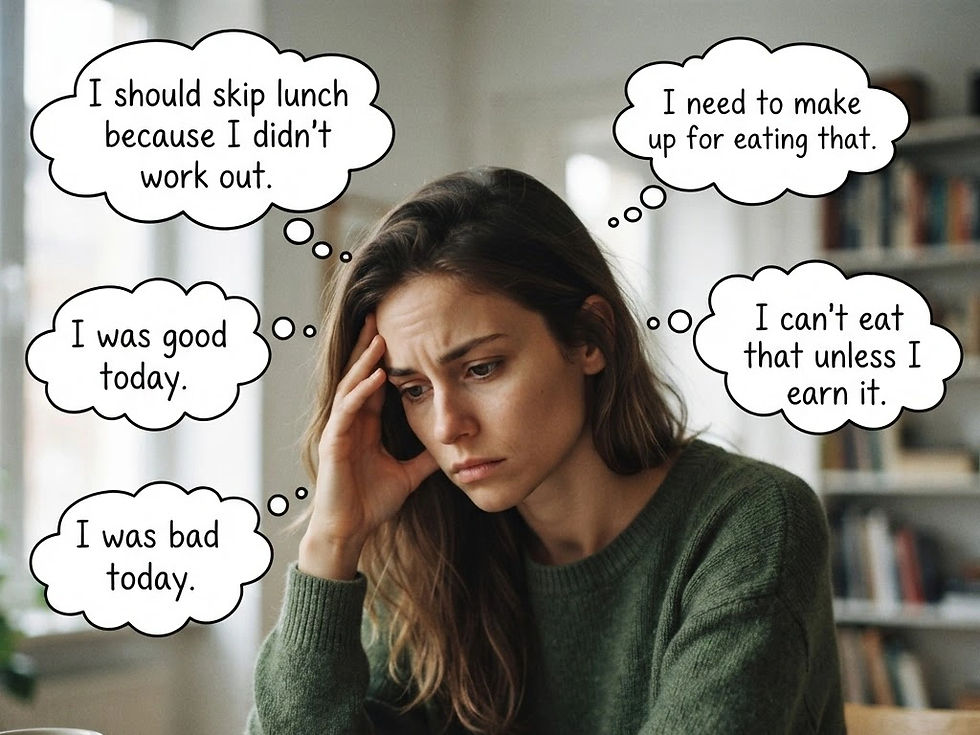
Recognizing Diet Culture Thoughts
The first step in changing any mindset is becoming aware of it.
Pay attention to thoughts such as:
"I should skip lunch because I didn't work out."
"I was good today."
"I was bad today."
"I need to make up for eating that."
"I can't eat that unless I earn it."
These thoughts often sound automatic because you've practiced them repeatedly. The goal is not to eliminate them immediately. The goal is to notice them. Awareness creates an opportunity to choose a different response.
Reframing Your Internal Dialogue
One of the most effective strategies is cognitive reframing. When a diet-culture thought appears, challenge it with a more balanced perspective.
Instead of:
"I need to burn off what I ate last night."
Try:
"My body needs consistent nourishment today regardless of yesterday's choices."
Instead of:
"I didn't work out, so I should eat less."
Try:
"My body still requires energy for basic functioning and daily activities."
Instead of:
"I was bad."
Try:
"Food choices do not determine my worth as a person."
Repeated reframing weakens old beliefs while strengthening more supportive, realistic ones.
Stop Asking What to Remove
Many diets focus on restriction.
The question is often:
"What should I cut out?"
A more helpful approach is asking:
"What can I add?"
This mindset shift promotes nourishment rather than deprivation.
Consider:
Adding protein to breakfast
Adding fruit to a snack
Adding healthy fats for satisfaction
Adding vegetables for variety and nutrition
Adding planned snacks to prevent energy crashes
When we focus on what we can add, eating begins to feel supportive rather than restrictive.
Rebuild Trust in Your Body
Years of dieting can make it difficult to recognize internal cues. Many people become experts at counting calories while losing touch with hunger, fullness, satisfaction, and energy needs.
Start practicing curiosity about your body's signals.
Before meals, ask:
How hungry am I?
What would satisfy me right now?
After meals, ask:
Do I feel comfortable?
Do I feel energized?
Am I satisfied?
These questions help reconnect you with the body's natural feedback system.

Separate Movement from Punishment
One of the biggest mindset shifts involves changing your relationship with exercise. If you use movement mainly to compensate for eating, it becomes hard to maintain a healthy, enjoyable exercise routine.
Instead, ask yourself:
What kinds of movement do I actually enjoy?
How do I want movement to make me feel?
What helps me feel stronger or more energized?
What supports my mental health?
When movement is tied to enjoyment and well-being, consistency becomes much easier.
Action Steps to Begin Shifting Your Mindset
Change doesn't happen overnight. Start with small, intentional practices.
1. Catch One Diet-Culture Thought Each Day
Write down one thought that sounds like:
"I should..."
"I shouldn't..."
"I earned..."
"I need to make up for..."
"I deserve...
Then write a more compassionate and realistic replacement statement.
2. Practice the "Add, Don't Subtract" Question
At one meal each day, ask:
"What can I add to make this meal more nourishing and satisfying?"
3. Check In With Hunger and Energy
Take 30 seconds before eating to ask:
How hungry am I?
What am I craving?
What would help me feel physically and mentally fueled?
4. Identify Your Non-Scale Goals
Think beyond weight. What matters most to you?
Examples include:
Having energy for your children
Improving athletic performance
Supporting mental health
Aging with strength and mobility
Feeling more focused at work
Write down three goals unrelated to the scale.
5. Redefine Movement
This week, choose one form of movement because you enjoy it, not because it burns calories.
Examples:
Walking with a friend
Dancing
Yoga
Hiking
Playing a sport
Strength training
Notice how your experience changes when enjoyment becomes the goal.
The Bottom Line
A healthy relationship with food is not built through guilt, strict rules, or earning your meals. It is built through trust, consistency, and self-compassion.
Food is not a reward.
Food is not a moral issue.
Food is not something you must earn.
Food is fuel, nourishment, pleasure, connection, and care.
The journey from earning food to fueling your life is not about perfection. It is about learning to trust that your body deserves nourishment every day, exactly as it is.
And that is a mindset shift worth making.
Reflection Question
This week, ask yourself:
"If I believed that my body deserved nourishment regardless of what I ate yesterday or whether I exercised today, what would I do differently?"
Your answer may be the first step toward a healthier and more peaceful relationship with food. If you need support in this transformational journey, reach out. Help is only a click away.


Comments