
Front Loading Your Day: A Simple Shift That Can Help You Rebuild Trust with Your Body

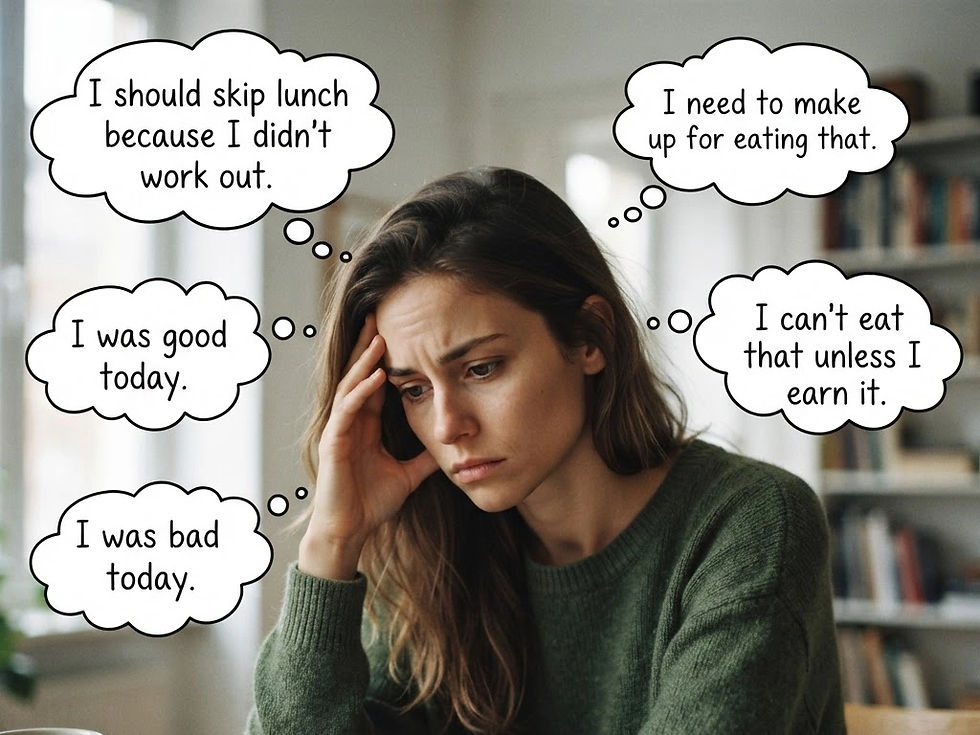
In my recent blog, From Earning Food to Fueling Your Life, I talked about how diet culture teaches us to view food as something we have to deserve. We learn to "be good," delay eating, push through hunger, and save food for later as a reward for getting through the day.
The problem is that our bodies don't work that way.
Our bodies aren't keeping score. They aren't handing out gold stars for skipping breakfast or waiting until 3 p.m. to eat lunch. They are constantly sending us information about what they need, and when we repeatedly ignore those signals, things often become harder, not easier.
That's why I want to talk about a concept called front loading.
Before you stop reading because it sounds like another nutrition buzzword, let me reassure you: front loading isn't a diet. It isn't about eating less. It isn't about restriction or earning your dinner.
It's about nourishment and properly fueling your body.
More specifically, it's about giving your body enough nourishment earlier in the day so you're not trying to solve a biological problem with willpower by evening.

The Pattern I See Again and Again
As a dietitian, I've had countless conversations that go something like this:
"I do great all day, but I can't stop snacking at night."
Or:
"I'm very disciplined until after dinner."
Or:
"I know what I should be eating, but by the evening I just don't seem to care anymore."
And then we start walking through their day.
Breakfast? Coffee.
Lunch? Something small squeezed in between meetings.
Afternoon? Maybe a protein bar, maybe nothing.
Then dinner arrives, and suddenly they're starving. A few bites while cooking turn into a full plate. One helping becomes two. The pantry starts calling their name around 8 p.m., and before they know it, they're feeling frustrated, guilty, and convinced they somehow lack self-control.
But here's what I often see. They don't have a willpower problem. They have a nourishment and fueling problem.
Your Body Is Trying to Help You
Imagine driving your car all day with the fuel light on. You might manage for a while. You could ignore the warning. You could tell yourself you'll get gas later. But eventually that car is going to demand attention.
Our bodies work much the same way.
When we consistently under-fuel throughout the day, our hunger signals become louder. Food becomes more appealing. Cravings become stronger. The foods that promise quick comfort and quick energy suddenly seem impossible to resist.
That's not weakness.
That's biology doing exactly what it's designed to do.
What Front Loading Really Means
Front loading simply means shifting more nourishment and fuel to the first half of your day. Not forcing yourself to eat a giant breakfast. Not following a rigid meal schedule. Not counting every calorie. Just making sure your body is receiving consistent fuel before you reach the point of running on empty. This is especially important if you exercise in the morning.
For some people, that might mean eating breakfast instead of skipping it. For others, it might mean building a more satisfying and balanced lunch. For someone else, it could mean adding an afternoon snack so they don't walk through the front door absolutely ravenous.
The specific strategy matters less than the principle. Fuel your body before it has to beg for fuel.
The Missing Link Between Physical Hunger and Emotional Eating
One thing I wish more people understood is that emotional eating and physical hunger often overlap. As I teach in my book, "Food Isn't the Problem," you can be physically hungry and emotionally hungry at the same time. When we talk about emotional eating, we tend to focus on stress, loneliness, boredom, frustration, or overwhelm. Those experiences absolutely influence food choices.
But when someone is emotionally drained and physically hungry? That's when eating can feel completely out of control. Think about how differently you handle stress after a nourishing breakfast, balanced lunch, and satisfying afternoon snack compared to how you handle stress after a coffee, a rushed salad, and six hours without eating.
The same stressor will often feel much bigger when your body is depleted. This is why front-loading isn't really about weight. It's about creating a foundation that allows you to respond to your emotions rather than react to them. When basic physical needs are met, it's easier to pause and ask:
"Am I hungry?"
"Am I stressed?"
"What would actually help right now?"
Those questions become much harder to answer when your body is waving hunger flags you've ignored all day.

Rebuilding Trust Looks Like Responding to Hunger
In my previous blog, I wrote about moving away from the idea that food must be earned.
This is one of the most practical ways to put that idea into action.
Every time you eat breakfast because you're hungry, even though the old diet voice says you should wait, you're rebuilding trust.
Every time you pack a real lunch instead of trying to "save calories," you're rebuilding trust.
Every time you choose nourishment and fuel because your body is giving you hunger signals during the day, rather than relying on willpower at night, you're rebuilding trust.
Trust isn't built through perfection. It's built through consistency. It's built when your body learns that hunger will be met with food instead of negotiation.
A Gentle Experiment
If you struggle with evening cravings, late-night snacking, or feeling out of control around food after dinner, I'd encourage you to approach this as an experiment rather than a rule.
Ask yourself:
What would it look like to nourish myself a little more at breakfast?
What would make lunch truly satisfying?
Am I going too many hours without eating?
How would my evenings feel if I arrived there already nourished instead of depleted
You don't need to overhaul your life overnight. Start small. Add more protein to breakfast. Include a more satisfying lunch. Pack an afternoon snack. Notice what changes. Notice how your energy feels. Notice how your evenings feel. And most importantly, notice what happens when you stop asking your body to wait all day for the fuel it needed hours ago.
Because sometimes the path toward feeling more peaceful around food isn't found through greater discipline and eating less.
Sometimes it's found through giving yourself permission to eat enough, soon enough, and often enough to feel cared for all day long.


Comments